00:00:00
one|Lesson 1~10
Lesson 1~2
✨课文
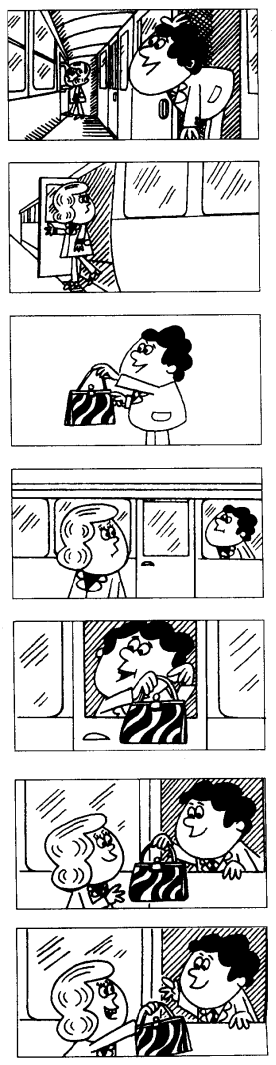
Preview
是否显示中文翻译
Excuse me!
Yes?
Is this your handbag?
Pardon?
Is this your handbag?
Yes, it is.
Thank you very much.
✨单词
⚡本课重点
be动词:是系动词中的一种,前期先记住以下三种变化形式
am,只能跟在第一人称单数I后面,例如 I am a student.is,跟在第三人称单数he、she、it等后面,例如 She is a girl.are,搭配you使用,不管是单数还是复数,例如 You are a girl too.
主系表结构:通常由主语+谓语+表语构成,其中谓语动词通常是由系动词来充当,常用来表达什么是什么或什么怎么样
- e.g. He is a teacher.
he是主语,is是谓语,a teacher是表语 - e.g. The sky is blue.
the sky是主语,is是谓语,blue是表语
一般疑问句:通过主谓倒装可将带有be的陈述句变为一般疑问句,即将be的适当形式移至主语之前
- e.g.
He is a teacher.=> Is he a teacher? 把be动词提到主语he的前面
Lesson 3~4
✨课文
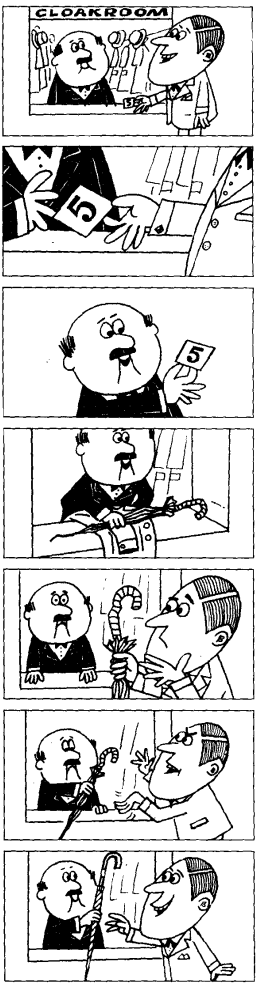
Preview
是否显示中文翻译
My coat and my umbrella please.
Here is my ticket.
Thank you, sir. Number five.
Here's your umbrella and your coat.
This is not my umbrella.
Sorry sir.
Is this your umbrella?
No, it isn't.
Is this it?
Yes, it is. Thank you very much.
✨单词
⚡本课重点
巩固主系表结构,掌握含有be动词的简单陈述句
肯定句
- e.g. This is my umbrella.
否定句:与肯定陈述句相反,它表示「否定」涵义,并且含有一个如not之类的否定词。当含有be动词的句子如果变为否定句,就是在be动词的后面加上not
- e.g. This is not my umbrella.
针对一般疑问句的否定简答语是No, it's not.或No, it isn't.
祈使句:用来表达命令、要求、请求或劝告等,它的主语是you(即听的一方),但通常不显示说明
结构:动词原形+名词(代词)
- 以动词原形开头的句子,或在动词原型前面加
do(只限于省略第二人称主语的句子)的句子,都是祈使句,Open the window, please. - 以
let开头的句子也是祈使句,Let's go shopping.
倒装句:be动词放在here的后面,就可以成为简单的倒装句式
- e.g. Here is my umbrella.
其他补充:习惯用语,it suits me
Lesson 5~6
✨课文
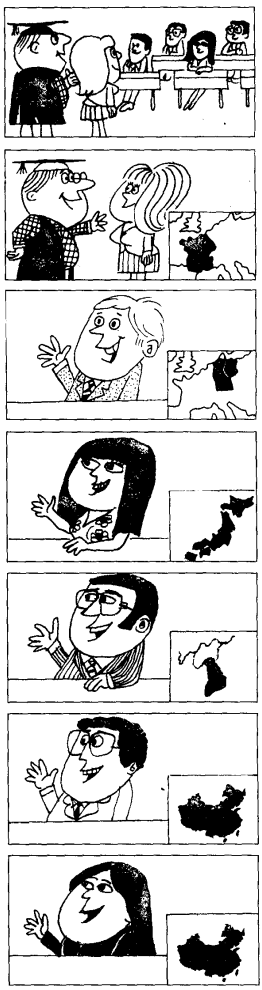
Preview
是否显示中文翻译
Mr. Blake: Good morning.
Students: Good morning. Mr. Blake
Mr. Blake: This is Miss Sophie Dupont. Sophie is a new student. She is French.
Mr. Blake: Sophie, this is Hans. He is German.
Hans: Nice to meet you.
Mr. Blake: And this is Naoko. She's Japanese.
Naoko: Nice to meet you.
Mr. Blake: And this is Chang-woo. He's Korean.
Chang-woo: Nice to meet you.
Mr. Blake: And this is Luming. He's Chinese.
Luming: Nice to meet you.
Mr. Blake: And this is Xiaohui. She's Chinese too.
Xiaohui: Nice to meet you.
课文理解
✨单词
⚡本课重点
选择疑问句:含有or的疑问句称为选择疑问句。选择疑问句的回答必须要用完整的句子,选择疑问句的语调为前升后降。or连接的两个并列成分可以是状语、宾语、表语、谓语或是两个分句
- e.g. Is she German or Swedish?
不定冠词a和an:
a和an具有不确定的意思a和an只能用于单数可数名词的前面a用于辅音音标的普通名词之前,发音为/ə/an用于元音音标的单词之前,发音为/ən/
e.g. This is a B/C/D/G/J/K/P/Q/R/T/U/V/W/Y/Z、This is an A/E/F/H/I/L/M/N/O/S/X
称呼的用法:
- Mr. (未知)
- Mrs. (特指已婚女士)
- Miss (特指未婚女士)
- Ms. (未知)
根据经验,大部分情况下使用Mr.和Miss就行
Lesson 7~8
✨课文
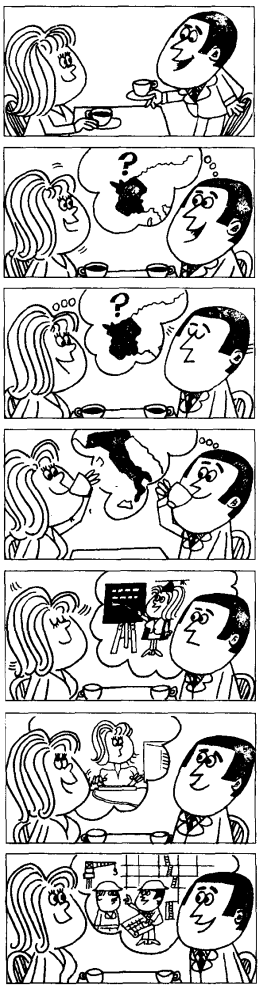
Preview
是否显示中文翻译
Robert: I am a new student. My name is Robert.
Sophie: Nice to meet you. My name is Sophie.
Robert: Are you French?
Sophie: Yes, I am
Sophie: Are you French, too?
Robert: No, I am not.
Sophie: What nationality are you?
Robert: I'm Italian.
Robert: Are you a teacher?
Sophie: No, I'm not.
Robert: What's your job?
Sophie: I'm a keyboard operator.
Sophie: What's your job?
Robert: I'm an engineer.
课文理解
✨单词
特殊疑问句
⚡本课重点
特殊疑问句:以特殊疑问词引导的问句都叫特殊疑问句。与一般疑问句的区别在于特殊疑问句不可以用yes或no回答
结构为: 特殊疑问词+助动词+主语+实义动词 或者是 特殊疑问词+一般疑问句(去掉答案)
| what | when | which | why | where | how | who | whom | whose |
|---|---|---|---|---|---|---|---|---|
| 什么 | 何时 | 哪一个 | 为什么 | 哪里 | 如何 | 谁 | 谁(宾格) | 谁的 |
too和either:两者都表示「也」的意思,too一般用于肯定句,either用于否定句和疑问句,它们一般都是放在句尾,且前面通常用逗号隔开
询问国籍:What nationality are you? 等价于 Where are you from?
Lesson 9~10
✨课文
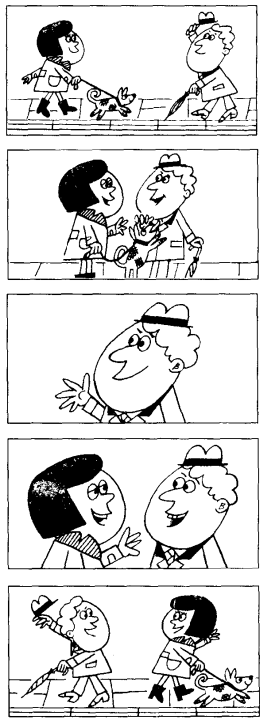
Preview
是否显示中文翻译
Steven: Hello, Helen.
Helen: Hi, Steven.
Steven: How are you today.
Helen: I'm very well, thank you. And you?
Steven: I'm fine, thanks.
Steven: How is Tony?
Helen: He's fine, thanks. How's Emma?
Steven: She's very well, too, Helen.
Steven: Goodbye, Helen. Nice to see you.
Helen: Nice to see you, too, Steven. Goodbye.
课文理解
✨单词
⚡本课重点
how引导的特殊疑问句
- e.g. She's very well today. => Is she well today? => How's she today?
先把陈述句中的be动词提到句首得到一般疑问句,再用how对一般疑问句中的答案well进行提问,并将how提到句首
形容词:形容词用来修饰名词,表示人或事物的性质、特征。通常可将形容词分为「性质形容词」和「叙述形容词」,其位置不一定都放在名词的前面。英文的形容词用法和中文语境中的用法是保持一致的
- 直接说明事物的性质或特征的形容词是「性质形容词」,它有级的变化,可用程度副词进行修饰,在句中可作定语、表语和补语
- 「叙述形容词」只能作表语,所以又称为表语形容词。这类形容词没有级的变化,也不能用程度副词进行修饰,大多数以
a开头的形容词都属于这一类 - 形容词作定语修饰名词时,要放在名词的前面。但是形容词修饰以
thing结尾的词语时,可放在这些词的后面